
The High-Tech Simulations of FSU's Nursing Program
Nov 18, 2026 9:00 AM
By Megan Knox '24
Walking into the nursing simulation lab inside Frostburg State University’s Education and Health Sciences Center, it’s easy to assume you’re stepping onto a real hospital floor.
Inside the lab, hospital beds line the room with patient monitors and mannequins lying in the beds, waiting to be evaluated and diagnosed by students. As the nursing industry advances, so must the simulations students use.
FSU’s Nursing Simulations Operations Specialist Areka Lashley has spent over three years transforming and perfecting the program’s labs behind the scenes. As a former cardiovascular unit bedside nurse, Lashley joined FSU when the EHSC building first opened, instantly taking on the task of building a realistic clinical lab environment from scratch. Today, Lashley continues to guide the program through the modern era of medicine with a more hands-on, virtual simulation.
While the classroom mannequins have been a lab staple since the FSU nursing program launched, they come with limitations.
“One gap that we saw was that I couldn’t really make a mannequin’s lungs sound the way I want them to while working with real people,” Lashley said.
To remedy this challenge, FSU began “Wellness Days” where real-life patient volunteers, ranging from pediatrics to geriatrics, would come to campus for nursing students to perform routine checkups on them to gain experience. But even that was limited.
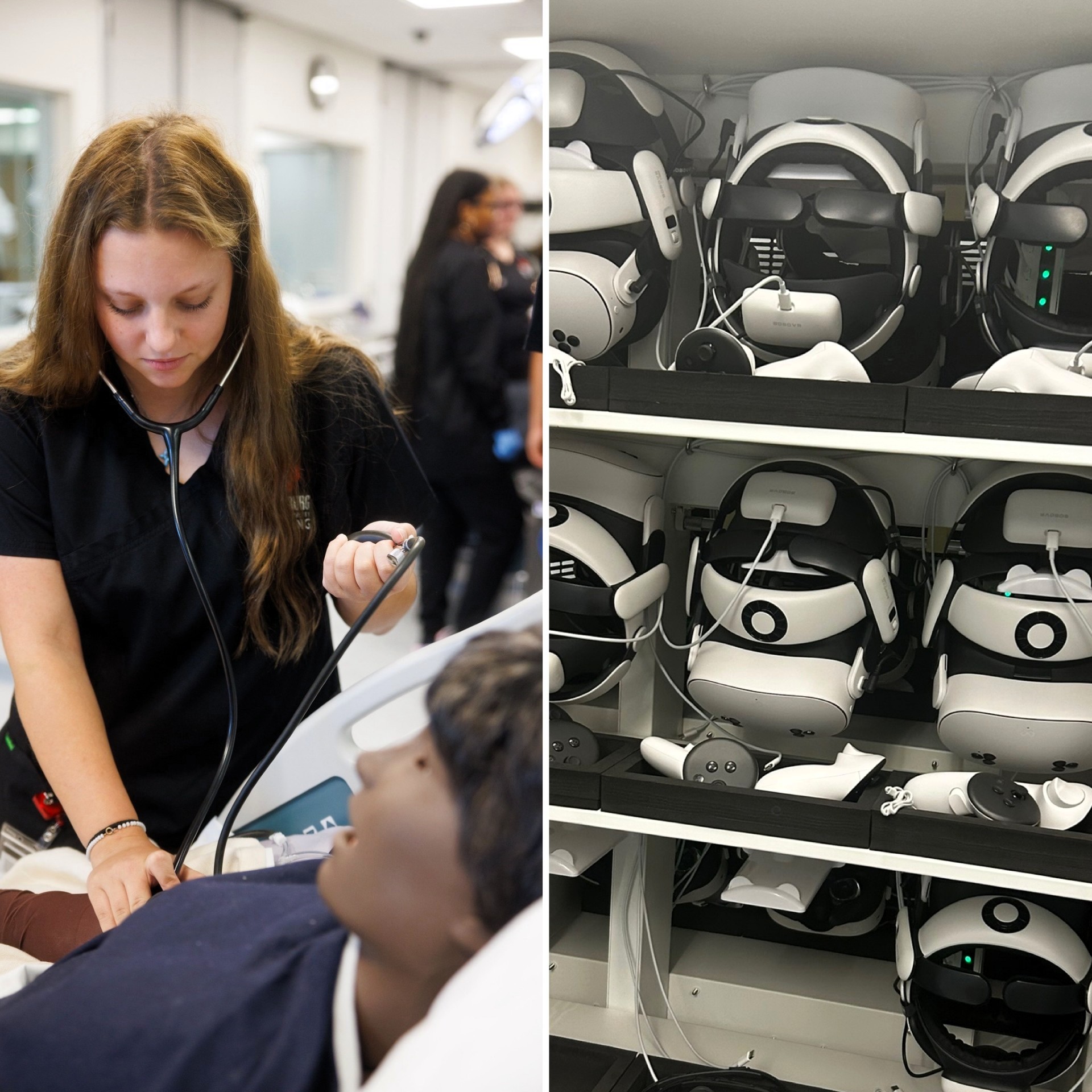 To elevate their clinical experience, the department integrated lightweight audio vests called Evo AuRA vests for the patient mannequins. The vests are used to listen for realistic heart, lung and bowel sounds with a programmed stethoscope.
FSU also secured a grant to purchase 20 virtual reality (VR) headsets, which rolled out to junior nursing classes. Despite some skepticism surrounding VR in healthcare training, Lashley pointed out how quickly the technology proved its worth.
“It really gives the students the opportunity to be in the clinicals by themselves, really taking care of a patient.”
From an operational standpoint, VR presents major advantages. It reduces the needs for consumable supply usage, eliminates physical equipment teardown and allows for rapid scenario expansion such as pediatric and obstetric simulations without requiring additional space or costly inventory.
Managing a multi-layered environment such as this requires serious coordination behind the scenes. On busy days, Lashley and her colleagues run up to four computers simultaneously to cast video feeds, control audio vests, monitor VR sessions and operate mannequins alongside specialized tools such as Anatomage tables, a 3-dimensional life-sized interactive virtual dissection system.
The investment comes at a crucial time when FSU’s nursing cohorts have expanded from 21 students to 34 in recent rotations. With a heightened interest in healthcare careers post-COVID, it has brought a demand of immersive training more essential than ever before for the incoming students.
As FSU’s nursing program continues to expand, Lashley sees the simulation technology evolving even further over the next three to five years with potential additions such as AI and expanded VR modules.
By pairing these advanced tools with real experience, Frostburg State is ensuring its nursing graduates leave campus not just with textbook knowledge, but with realistic clinical experience that will help them with their experiences in their healthcare careers.
“The program is going to keep growing,” Lashley said. “The technology is going to be really game-changing for the students, so I’m excited to see what else we’ll be seeing.”
Click HERE to learn more about FSU’s Nursing Program.